
A Sector-Wide Capacity-Building Initiative in Partnership with HRSD, ECRA & Arabian Child
| 1,600+ HRSD-licensed centers in target ecosystem | 500+ Early childhood professionals trained | 75 Centers registered for ECRA self-evaluation |
National Context
Saudi Arabia’s Vision 2030 places strong emphasis on expanding access to high-quality early childhood education. As enrollment increases and new centers open across the Kingdom, ensuring consistent standards across providers has become a national priority.
To support this objective, the Ministry of Human Resources and Social Development (HRSD) launched a sector-wide initiative in collaboration with the International Early Childhood Rating & Accreditation (ECRA) and Arabian Child. The initiative provided licensed early childhood centers with accessible tools and professional development resources enabling structured quality improvement.
The program targeted all HRSD-licensed early childhood centers in Saudi Arabia — both private and non-profit providers. At the time of launch, more than 1,600 centers were licensed by HRSD in the region.
Sector Challenge
Rapid expansion of the early childhood sector created systemic challenges across centers:
- Lack of standardized quality frameworks
- Inconsistent classroom environments
- Weak implementation of health and safety procedures
- Limited structured professional development for staff
- Minimal use of data or self-evaluation for improvement planning
While many centers were committed to improvement, many lacked the tools and guidance required to conduct structured quality reviews and develop actionable improvement plans. HRSD sought to introduce a nationally scalable mechanism for quality benchmarking and capacity building.
The Initiative: Three Core Components
The program was designed as a sector-wide capacity-building initiative enabling centers to begin a structured quality improvement journey. It was built on three interconnected pillars:
| 01 ECRA Self-Evaluation Tool | 02 Capacity-Building Training | 03 Strategic Planning Support |
| • 6 quality domains • 80 benchmarked standards • 75 centers registered • Structured gap analysis |
• All 6 domains covered • Structured sessions • 500+ professionals trained • Directors & teaching staff |
• Center improvement plans • Policy strengthening • Staff dev alignment • Hadaf qualifications |
01 — ECRA Self-Evaluation Tool
Licensed centers were invited to register for the ECRA Early Childhood Self-Evaluation Tool, which enables centers to assess their practices across 6 quality domains and 80 internationally benchmarked standards. The tool provides a structured framework allowing center leaders to identify strengths, gaps, and priority areas for improvement. In the first phase, 75 centers registered to complete the self-evaluation process.
02 — National Capacity-Building Training Series
Arabian Child delivered a structured national professional development program aligned with the six ECRA quality domains and the full set of ECRA standards. The training focused on helping center leaders and staff understand quality indicators, interpret the ECRA framework, conduct internal self-evaluations, and develop practical center-level improvement plans. The program was designed to be accessible to center directors, administrators, and teaching staff across licensed early childhood centers. The training program was accredited by the Technical and Vocational Training Corporation, while the Ministry of Human Resources and Social Development supported the initiative by promoting awareness of the program and encouraging center leadership to participate.
03 — Strategic Planning Support
In addition to the training, participating centers received structured guidance on translating their self-evaluation results into practical improvement strategies through a detailed action report. The report highlighted each center’s strengths and areas requiring development across the six ECRA quality domains. Using a digital platform built with business intelligence and artificial intelligence capabilities, center directors were able to download the report and use it as a foundation for developing their center’s quality improvement plan.
Implementation Journey
The initiative followed a structured five-stage improvement pathway, intentionally designed as a scalable national support system enabling a large number of centers to begin quality improvement without requiring full external audits.
| 1 | Orientation | Introduction to the ECRA framework and quality domains |
| 2 | Self-Evaluation | Centers assessed across all 80 standards |
| 3 | Training | Staff trained across all 6 quality domains |
| 4 | Improvement Plans | Centers developed action plans from results |
| 5 | Ongoing Development | Leaders pursue structured professional development |
Early Outcomes
While the initiative focused primarily on capacity building and self evaluation rather than external evaluation, participating centers reported several tangible improvements:
| ✔ | Improved awareness of quality standards | Center leaders gained a clear understanding of high-quality early childhood environments and operations. |
| ✔ | Stronger internal documentation | Many centers formalized operational policies, health and safety procedures, and curriculum planning documentation. |
| ✔ | Identification of professional development needs | Through self-evaluation, centers identified staff training priorities aligned with national workforce development initiatives. |
| ✔ | Increased engagement with quality improvement | The program introduced a structured process for continuous improvement that most centers had not previously implemented. |
Alignment with Vision 2030
This initiative directly supports several strategic priorities under Saudi Vision 2030, contributing to a stronger, more equitable early childhood ecosystem across the Kingdom:
| Vision 2030 Priority | How This Initiative Contributes |
| Quality ECE services | Improving the quality of early childhood education services across the Kingdom |
| Workforce capability | Strengthening professional competencies in the early childhood education sector |
| Evidence-based quality | Promoting structured, data-informed quality assurance frameworks |
| Safe learning environments | Supporting stimulating, safe environments for young children |
Conclusion
This initiative represents an important step toward establishing a national culture of quality improvement in early childhood education. By combining a structured self-evaluation tool with professional development and strategic guidance, the program enabled centers to engage with quality standards in a practical and accessible way.
Through collaboration between government institutions, quality assurance authorities, and professional development providers, the HRSD–ECRA–Arabian Child initiative contributes meaningfully to building a stronger early childhood ecosystem across the Kingdom — in direct alignment with the aspirations of Vision 2030.
| HRSD Ministry of Human Resources & Social Development |
ECRA International Early Childhood Rating & Accreditation |
Arabian Child Professional Development & Capacity Building |
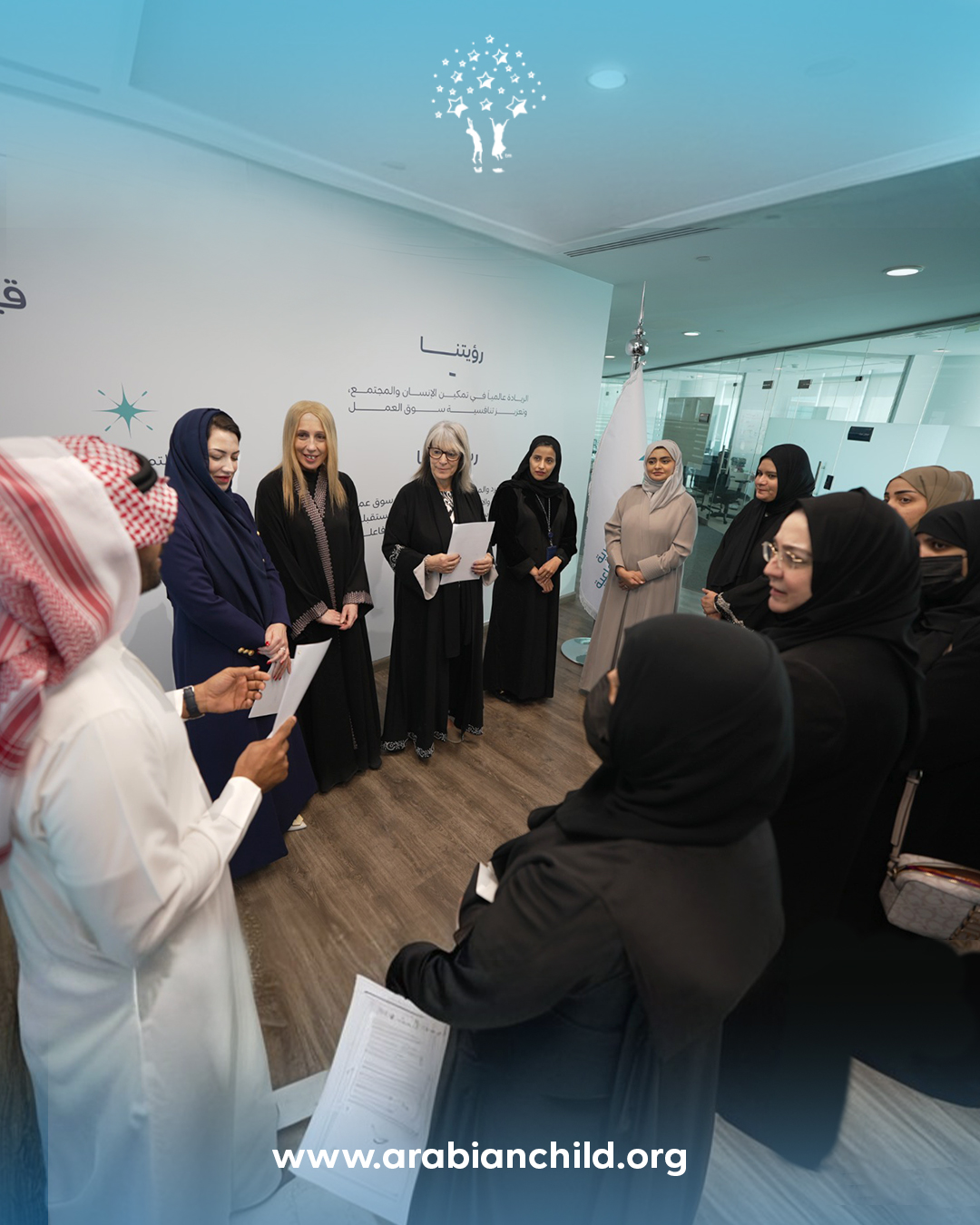
Strategic Memorandum of Understanding Signed With HRSD
Arabian Child formally signed a Memorandum of Understanding (MoU) with the Ministry of Human Resources and Social Development (HRSD) and the International Early Childhood Rating & Accreditation Authority (ECRA) to support a national initiative aimed at strengthening the quality of early childhood services across Saudi Arabia.
The agreement establishes a collaborative framework to provide licensed early childhood centers with structured quality improvement tools, professional development opportunities, and technical guidance aligned with international standards.
Through this partnership:
- HRSD supports the initiative by encouraging participation among licensed centers and promoting sector-wide engagement.
- ECRA provides the international quality framework, self-evaluation system, and technical benchmarking standards.
- Arabian Child delivers structured professional development programs and practical implementation guidance for early childhood leaders and educators.
The signing of the MoU represents a significant milestone in strengthening collaboration between government institutions, international quality authorities, and sector development organizations, supporting Saudi Arabia’s broader goal of advancing early childhood education in alignment with Vision 2030.
The ECRA Quality Improvement App
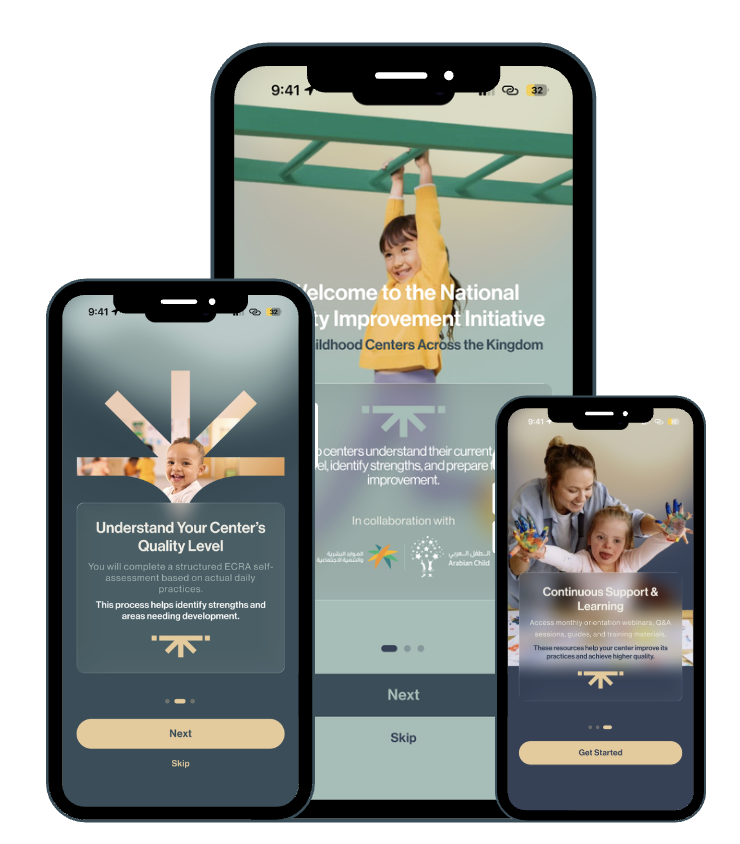
As part of the national quality improvement initiative, a dedicated ECRA mobile application was developed to support early childhood centers in implementing structured self-evaluation and continuous improvement.
The application provides center leaders and staff with an accessible digital platform that simplifies quality assessment, supports professional development, and enables data-informed decision-making.
Designed specifically for early childhood environments, the app allows centers to evaluate their practices against the ECRA quality framework, monitor progress over time, and identify opportunities for improvement.
Key Features
Digital Self-Evaluation System
Centers can complete structured self-assessments aligned with the six ECRA quality domains and 80 standards, allowing leaders to evaluate performance and identify improvement priorities.
Real-Time Data Insights
Interactive dashboards provide leaders with instant visibility into performance indicators, strengths, and development areas to support informed decision-making.
Staff Development Resources
The platform includes curated training materials, professional guidance, and recommendations designed to strengthen teaching practices and staff competencies.
Operational Efficiency Tools
The application simplifies documentation, reporting, and follow-up tasks, helping centers manage quality improvement processes more efficiently.
A Scalable Digital Tool for Sector Improvement
The ECRA app enables early childhood centers to:
- Assess their current quality level
- Identify priority areas for development
- Monitor improvement over time
- Access training and professional learning resources
This digital approach allows the initiative to scale efficiently across a large number of centers while maintaining a structured and evidence-based quality improvement process.
Supporting Continuous Improvement
By integrating self-evaluation, professional development, and data analytics into a single platform, the ECRA application helps early childhood leaders move from periodic quality reviews toward ongoing, data-driven improvement cycles.
The platform therefore serves as a key operational tool supporting the broader HRSD–ECRA national quality improvement initiative.